In Eliot’s Midst – 29 May 2025
I write to you from the town and world of Middlemarch. Judging by this week’s conversations and sales, many of you are joining me, some returning, some making your first foray, thanks to that Guardian list or last week’s dispatch, whichever is the more influential.
How I love being back here.
George Eliot got it all in there didn’t she? Saints and rogues, real estate, religion, taxes, death, almost romances that never happen while the doomed marriages do, manners, gender roles, intricate architectural designs of both cottages and hair, political upheaval (so much discussion of ‘Reform’ unnerving today’s reader), characters who deserve the epic and instead get… a funereal, ‘old’ decidedly average scholar who thinks women can’t read Greek. Not to mention illegitimate children, villainous bankers, and an actress who murders her husband on stage because his adoration of her is so boring.
There are the brilliant descriptions from the kindness of Caleb Garth’s bushy eyebrows to Casaubon’s ‘iron-gray hair and his deep eye sockets’ next to the blooming, red-whiskered Sir James, to Ned’s expressive chin which has ‘too vanishing an aspect, looking as if it were being gradually reabsorbed. And it did indeed cause him some difficulty about the fit of his satin stocks, for which chins were at that time useful,’ to Dorothea – oh, Dorothea! – her beauty ‘thrown into relief by poor dress,’ so dignified next to her blushing sister, if lacking in common sense, and so bewitching on horseback that she’d better stop riding.
Then too there are the wry Fleabag-esque moments when Eliot herself pops in to joke about women whose writing is credited to men or to point out that she knows what’s coming for her characters which will prove them hypocrites even if they have no notion of it or to ask why we’re always hearing about things from Dorothea’s point of view when Casaubon, ‘in spite of [his] blinking eyes and white moles’ might have some inner life too.
And then there is this: ‘We do not expect people to be deeply moved by what is not unusual. That element of tragedy which lies in the very fact of frequency, has not yet wrought itself into the coarse emotion of mankind; and perhaps our frames could hardly bear much of it. If we had a keen vision and feeling of all ordinary human life, it would be like hearing the grass grow and the squirrel’s heart beat, and we should die of that roar which lies on the other side of silence.’
Perfect, isn’t it? All of life roaring in its pages. Actually, one complaint: I wanted more hats. But then I am not as virtuous as Dorothea or George Eliot.
May your weekend afford just a moment to hear the grass growing, without being driven mad,
Lizzie
Featured in the newsletter
-

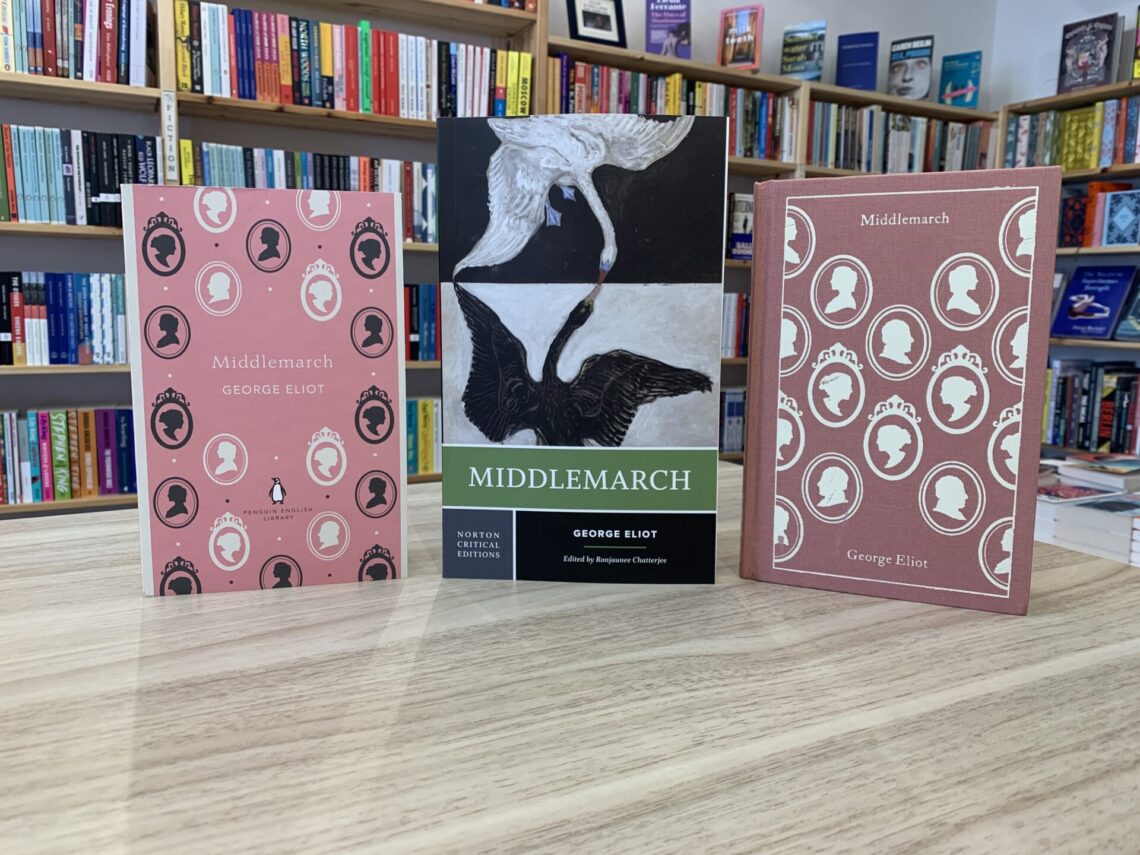
Middlemarch
£10.99 -
Middlemarch Clothbound Hardback
£25.00 -
Middlemarch: A Norton Critical Edition
£12.99