How to Split A Heron – 11 July 2025
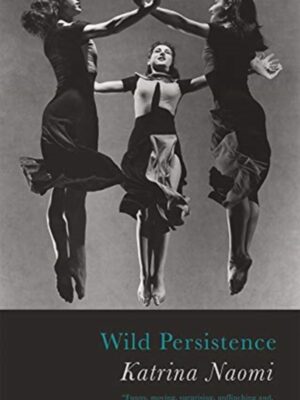
In Wild Persistence, Katrina Naomi imagines what she might do if she could divide herself in two. The poem ‘Dualism: A Manifesto’ is itself split across the page. One side of the whole can write, paint, wear stilettoes, belt out Shirley Bassey, while the other reads Iris Murdoch in cream and brown brogue. The two halves complement and oppose one another, a conflict explored throughout the collection. ‘One side of me could be utterly lovable,’ part of the page declares, ‘The other who I really am.’
The part of me that wants to be alone in a cave with a book and the part that wants to be discussing that book with people over a drink can come together tomorrow evening – two parts of the soul uniting in platonic bliss – for a poetry reading downstairs in the shop. Please do join us at 5pm for Poetry in Herons with Katrina Naomi.
Ahead of that, just a quick tour of the soul, splitting oneself in two, identity and twins (and therefore of dualism, Plato, immortality and morality)…
Orlanda by Jacqueline Harpman opens with Aline Berger, a scholar, struggling to concentrate on her book. She is in a café opposite the Gare du Nord waiting for her train back to Brussels. She is an anxious traveller, anxious in all sorts of other ways too. Or, at least, part of her is.
Opposite is a handsome, if unkempt, young man. ‘If I were inside his head, how would I see the part of me left sitting here?’ Aline wonders. And so, part of her, of which she has always been a little afraid or in awe – more energetic, more tempestuous, more liberated, as it is – leaves in order to find out. The part of her which takes over the young man’s body refers to himself as Orlanda. Needless to say, the book resting in Aline’s lap is Virginia Woolf’s Orlando.
Ros Schwartz’s updated translation of Orlanda has just been published, the novel having been unavailable here for some years. I approached it wondering if it could possibly be as good as Harpman’s extraordinary I Who Have Never Known Men and how much Orlando revision I ought to have undertaken.
I need not have worried about the latter – as with Percival Everett’s James or Xiaolu Guo’s Call Me Ishmaelle, a great novel inspired so explicitly by another can still contain all that the reader needs within the confines of its own pages. And about the former? Orlanda is even better than I Who Have Never Known Men. I am going to make all sorts of insufferable claims about it being one of the best books I have ever read. My full soul proclaims it so.
Part of me raced through it, delighting in the reckless plot, in the descriptions of clothes, physique and apartments which all have dual meanings and in the narrator who must split herself between her character’s two bodies. Part of me took more time, going back over each paragraph to explore every subtle slip and grand assertion. ‘It is a novel, a made-up story which only takes place in my head,’ the narrator insists. ‘I have no blood on my hands, just a little ink.’ I look forward to hearing what you make of that.
When Orlanda first leaves Aline, he sees it as a liberation from prison. Odd then to find myself turning directly from that to Sasha Debevec-McKenney’s Joy Is My Middle Name, to be met with the poem, ‘Your Brain is Not a Prison!’
The collection is full of freeing moments, of giddy lines and brilliant set-ups for scenes that deliver dry humour and a little unease. You will see what I mean when you read her poem about the film Babe, imagining the people who see a pig win a sheep herding competition and realise that no other sporting event can ever top this experience, or the one about meeting Sharon Olds whose title and contents are unrepeatable here (unless my parents skip reading this week).
I am currently reading The Catch by Yrsa Daley-Ward, a story of two halves which have struggled to make a whole. Clara and Dempsey are twins adopted as babies and brought up separately after their mother walked out and drowned herself in the Thames. Except that, on her thirtieth birthday, Clara has just seen their mother, very much alive and stealing a Rolex. And she has not aged a day. Dempsey is having none of it – the woman is a doppelgänger or just a con artist.
Clara is on her way to becoming a successful writer. Her debut novel Evidence is being received with rapturous acclaim. Chapters in The Catch are from Evidence. Things that happen to Clara after Evidence is published have already happened in her novel. Everything about Clara is a performance. Everything about her mother might be. It’s wild and brilliant.
Alongside The Catch and all its toying with appearance and presentation, it is fascinating to begin reading Reframing Blackness by Alayo Akinkugbe. Akinkugbe studied History of Art at Cambridge and founded A Black History of Art on realising that she might graduate without having studied a single Black artist or curator and without much consideration of the representation of Black people in Western art. The book explores Blackness in museums and art, the teaching of history of art and the curation of exhibitions and the discussions which result.
The twins in Miriam Bonastre Tur’s middle-grade graphic novel, Hooky have a rather better relationship than those in The Catch though perhaps the stakes are just as high. They have just missed the bus to magic school, something of a problem when the location of the school is a secret… Hoping to avoid their parents’ anger, instead of going home they fly to Aunt Hilde’s house and ask if they can stay there. They don’t expect to find themselves the subjects of a manhunt, let alone part of a war between witches and mortals…
While the twins are late for the school bus, I am some fifty years late in reading Tuck Everlasting by Natalie Babbitt, one of those intelligent and beautiful children’s books that every adult must read too. It is an exploration of the soul, of what it means to live if one cannot die, of the significance of time if one cannot age and of how to feel about an uncharismatic and very warty toad.
Part of me would like to go on to mention several other books which I had planned to write about this week. Part would like to pick up Orlanda again. I wonder which will win.
May your weekend be split between reading and more reading, or perhaps beset by banana splits,
Lizzie
Featured in the newsletter
-

Orlanda
£9.99 -
I Who Have Never Known Men
£9.99 -
Orlando (Vintage Classics Woolf Series)
£9.99 -
Wild Persistence
£9.99 -
Joy Is My Middle Name
£12.99 -
The Catch
£16.99 -
Reframing Blackness
£20.00 -
Tuck Everlasting
£7.99 -
Hooky Volume 1
£11.99