Everything is Lists and Hats – 12 December 2025
We resisted for as long as possible. There remain plenty of days and nights of 2025 on which books will be read. Nevertheless, here they are: The Book of the Year (up to 11 December) Lists. Yes, there are many books we have read this year which aren’t on there and should be. Yes, we might give a different answer on a different day. Yes, I considered making my whole list Barbara Pym novels. No, I do not know why we limited ourselves to fifteen books each. There is nothing scientific about this process.
We all have to pretend that it makes sense to put a picture book about a fox next to a novel about a gambler with a heart of gold and judge which is better. Behind the phony tinsel of Hollywood lies the real tinsel, as Samuel Goldwyn may have said.
Harry’s list comprises an examination of sexism and AI, a graphic novel about nuclear energy, a poetry collection about fleeing Iran and a story featuring a charismatic cockroach. Jon Fosse makes his appearance. I will wager that this will be the case every year until Harry retires and is no longer forced to make this list. And he’s, like, really young.
My list travels the Caucasus with inclement weather and politics alongside excellent recipes, traverses America, India and Italy with two people who love each other even if they hardly know it, returns to Cambridge and a favourite museum, drawing together light, time and art with Stoppard, Wittgenstein and Newton and ventures out to sea with William Blake.
Both lists feature fiction, non-fiction, poetry and children’s books yet somehow neither encompasses sentient meteorites: perhaps the masterpiece that is Sleep Tight, Disgusting Blob deserves its own category, a list of one if such a thing can be allowed.*
All of these end-of-year traditions – reflecting on what we’ve read, revisiting our favourites over mulled wine, staying late in the shop to find where a customer has hidden that copy of A Christmas Carol they were walking around with for an hour (who knew they could even reach the chandelier?), playing guess how much your shopping weighs in exchange for glory and chocolate buttons – had me a little giddy. So, I thought I’d read a sobering and sensible book about tuberculosis.
Turns out I was in for a wild ride, cowboy hat flying off behind me as I discovered the role of tuberculosis in popularising the Stetson, not to mention in the start of the First World War via the almost-comically incompetent assassins of Archduke Franz Ferdinand. In medical developments but also cultural ones, in history, geography and fashion, tuberculosis has its part to play and it is hard not to be as fascinated as John Green is by the subject and to conclude that, within reason, Everything is Tuberculosis.
In 2023, tuberculosis killed 1.25 million people. Yet it is preventable, treatable and curable. No one need die of tuberculosis today. The fact that they do, Green argues, is a decision.
Throughout the book he draws his research back to Henry, whom he meets in a hospital in Sierra Leone and takes to be a nine-year-old boy. Henry is in fact seventeen, emaciated by tuberculosis. It is through one person’s story that the incomprehensible number of 1.25 million begins to hit home. Green shows that the cures are where the cases are not, that this is due to poverty and racism and that this can be changed. Everything is Tuberculosis becomes a powerful call to treat everyone with love and compassion.
Having got to grips with the history of the world through a disease – itself featuring not a few romantic poets – I plan to brush up on A History of England in 25 Poems by Catherine Clarke. I have gone absolutely rogue and started part of the way through by reading the chapters on ‘Rules and Regulations’ by Lewis Carroll and ‘In Memoriam’ by Tennyson because both authors have been such a feature of the past couple of weeks and am thoroughly enjoying it. I must now go back to the beginning and revise my Anglo-Saxon…
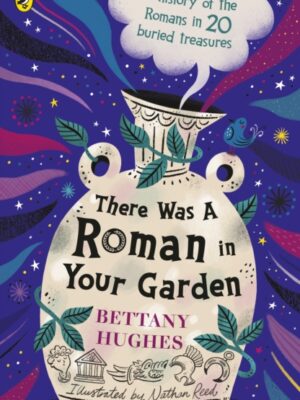
For younger historians and anyone interested in pizza or longships, There Was a Roman in Your Garden by Bettany Hughes and The Vikings by Harriet Evans are both brilliant. The former is a literary treasure chest buried by a Roman child and overflowing with the objects important to their everyday life which reveal what it was like to live in ancient Rome. The latter is a stunning and huge book about Viking religion, travel, trading and raiding with details to unearth behind flaps on every page – archaeological tools not included.
I’m off to consult my lists of all the books I intended to feature in this year’s newsletters. Just two more editions and I haven’t even started that 624-page book on Thomas More. Perhaps it’s not his year.
May your weekend glitter with sentient meteorites,
Lizzie
*Father, please check this for Aristotelian understanding of number and set theory.
Featured in the newsletter