Dress Code: Black Bag – 18 September 2026
When the spider the size of a fifty pence piece made her home above my bedside lamp, I felt revulsion. Her body has the gelatinous look of a Haribo sweet and as much to recommend it. One of us has to move, probably me, I thought. That glass and paper trick having gone awry too many times, I left her and her waving legs alone and prayed that she wouldn’t get cold and join me in bed.
Now that I’ve shared the room with her for some time, I have grown more tolerant. Sometimes I wish her good night. She has quietly been performing on me an experiment to test the mere-exposure effect: the more I see her the more I come to accept, even like, her.
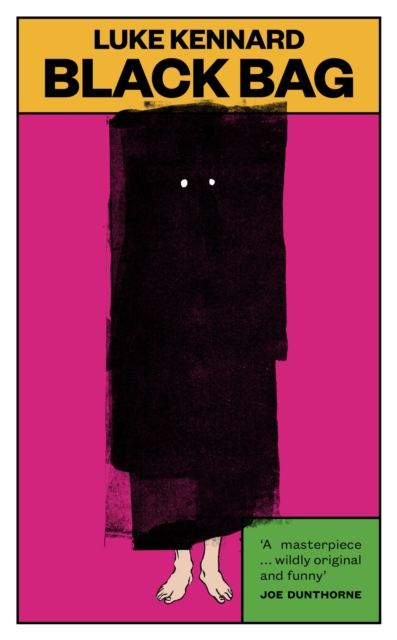
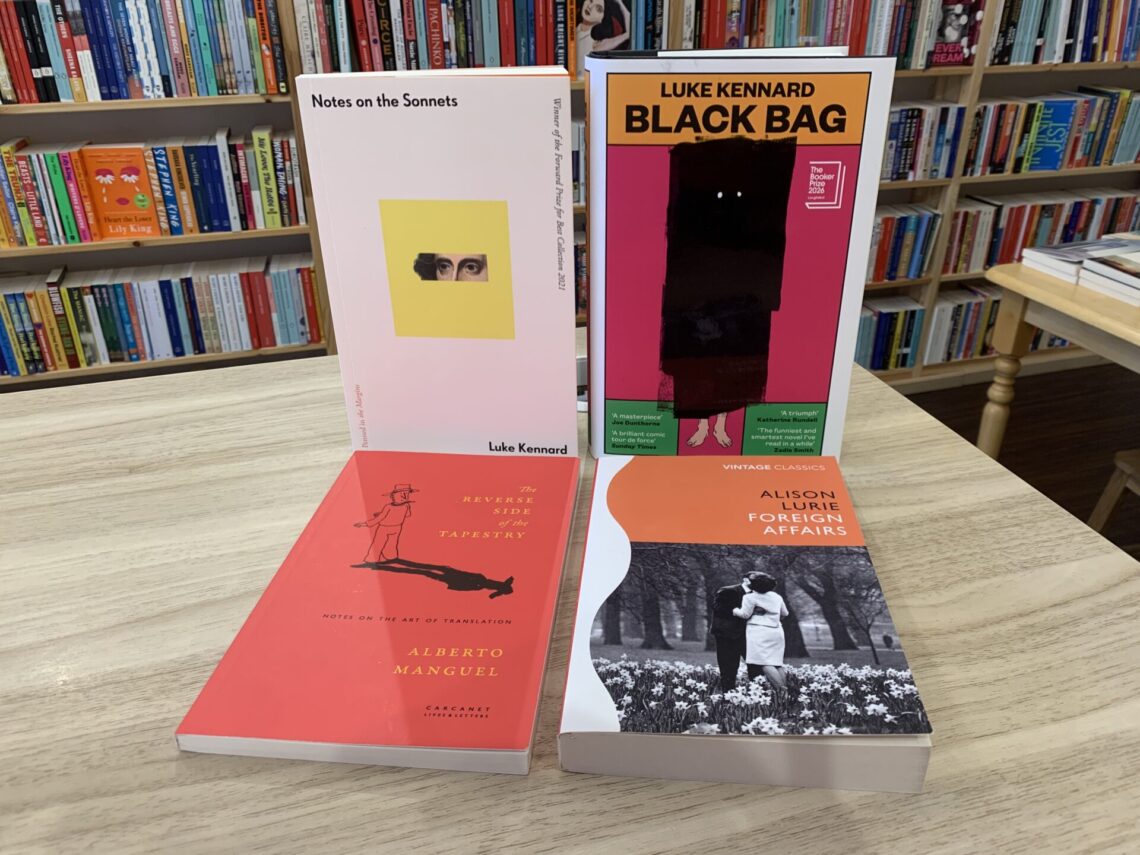
Another experiment to test this effect inspired Luke Kennard’s novel, Black Bag. The narrator is a largely out of work actor hired by a Psychology academic to put a black leather bag over his head – it stretches down to his knees and he is to wear nothing else – and sit in the back of Dr Blend’s lecture hall throughout the term. He must also attend a weekly seminar. He must arrive on campus in costume and character. He must not communicate in any way. The students are quick to file a complaint.
Black Bag, for this he becomes, is an actor unable to respond to his audience. Though, as a narrator, he acknowledges his reader. ‘If you met anyone as whiny, as disobliging and egocentric as the average narrator of a novel in real life you’d find them unbearable,’ he opens. ‘I’m not like that.’ Then he declares that he will speak to you in the present tense, ‘The silliest tense. And also the closest we come to talking directly to God.’
What have you zipped yourself into? A brilliant novel. Both plot and turn of phrase had me laughing out loud. And it doesn’t fit into any boxes or bags. People may tell you that this is a book exploring masculinity and shame. People may say that it is about the monetisation of our personal data and retreating from this world in which the personal has become public commodity. Some will say it’s about how art has been undervalued, humanity is doomed and AI is ‘coming for us.’ Some will say it’s about the future of academia. Some that it is about relationships, self-interest and being attracted to nothing. (That’s not, not being attracted to anything but being attracted to: nothing. It’s a Parmenides/Quine thing. Probably.)
Black Bag explores all of these – and it is refreshing and nimble as it does so – but it is also a book about a man wearing a black bag over his head. People mock him. It is hard to order a pint. Still harder to drink it. You try operating a pedalo.
Luke Kennard’s humour and skill is clear in his poetry too. I am immensely enjoying Notes on the Sonnets, a collection of prose poems responding to each of Shakespeare’s sonnets, set at the sort of all-night house party which one can’t quite leave even though the wrong people are kissing on the stairs, a mathematician is drawing sequences of infinite transcendental numbers on the window and there is a danger that someone is going to find the guitar.
‘Lo! in the orient when the gracious light,’ begins Sonnet 7, prompting the party-goer to declare ‘Language, although it’s not said so often, is actually brilliant. I mean just look at it. We took too many pointers from depressed short story writers when really language is so wonderful I can only celebrate it sub-lingually.’ Sonnet 25 elicits, ‘Posterity is like a cat that thinks it’s Jesus: we wouldn’t even know.’ ‘Shall I compare thee…’ provokes a consideration of the introduction of the Gregorian calendar, the discovery that the darling buds of May are, in the sixteenth century, shaken by the rough winds of July and an explanation as to why the tax year begins on 6 April.
Both books are fantastic entertainment whilst also being interested in how we experience that. ‘You are never at the same party as anyone else,’ the poet writes in Notes on the Sonnets, ‘and every room is filtered through every other room you’ve ever seen.’ You are never reading the same sonnet. In Black Bag, one character asks, ‘When you – you personally – buy a book you’re not buying a small quantity of paper and ink, right?’ You’re buying something intangible, stories, ideas, the way in which they’re expressed and the possibility of interacting with them.
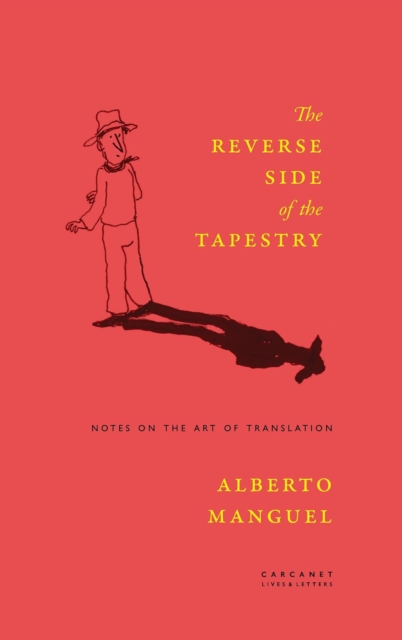
Not just that but the text, this apparently solidified thing, keeps changing. In his book on translation, The Reverse Side of the Tapestry*, Alberto Manguel writes that, ‘Inscribed in the very creation of a text is the hope of resurrection. This coming back to life is an endless process: reader after reader opens the book on the first page, and all these successive reawakenings become part of the text itself. We never read the original text: we read the enfolded history of its readings and re-readings.’
His short essays on the subject, named for the definition Cervantes gives of translation in Don Quixote, are full of such ideas, expressed succinctly but likely to cause hours of contemplation. Fortunately his cartoons permit pondering time.
Between Manguel’s and Kennard’s ideas about what a book is, what a translation is and should be, what we bring to reading something at a particular moment, in a particular place, spider looking on or not, and after a good or bad coffee, my head has been buzzing. I have settled myself into a rather different consideration of academia and literature with the novel Foreign Affairs by Alison Lurie.
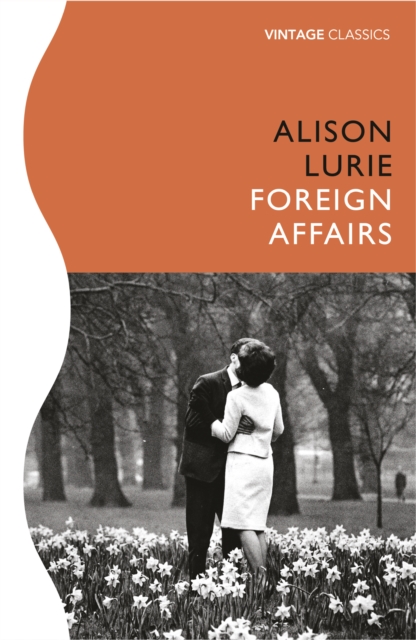
Vinnie Milner is an American, though spiritually English, professor of children’s literature travelling to London for research. She is accompanied by an imaginary and persistent dog named Fido. Before boarding the plane, she picks up a copy of the Atlantic only to find her own research belittled in this, her favourite magazine. On the plane, a man will not stop interrupting her reading until she lends him a copy of Little Lord Fauntleroy. At the airport her bag containing reams of research notes seems to be missing. To say nothing of the dog. It is an inauspicious start to what promises to become a gorgeous, witty and romantic story.
May your weekend take place in the silliest tense,
Lizzie
*Not that one. For that Tapestry, please see last week’s newsletter.**
**Yes, I still know it’s an embroidery but Tapestry evokes it. Language, eh?
Featured in the newsletter
-

The Reverse Side of the Tapestry
£14.99 -

Black Bag
£18.99 -

Foreign Affairs
£9.99