The Heron Lifestyle – 23/11/2024
Before opening the shop, I had never been on Instagram. This meant that I had never referred seriously to ‘My Story.’ And I had never taken a picture of my food. I would just… eat it.
Hard to believe now as I scatter Halen Môn pumpkin salt spice on my morning coffee, line up the handles of my Le Creuset mug and Bialetti Moka Pot at a pleasing angle on William Morris print coasters, consider whether a vase of flowers is needed in the background to add another level, hide the kitchen roll visible in one corner of the table (kitchen roll? I only use linen napkins in muted tones) all to photograph a book to its best advantage – its cover contains dashes of the same burgundy as my coffee cup.
But wait. Will this post alienate all French and all Italian customers by revealing that I do indeed mix these two brands every morning? A quick search reminds me that Le Creuset is French-Belgian so that’s a third nation appalled by my choices and, oh god, what will happen when someone finds out that I’m using Lavazza coffee which I keep stored in an Illy tin in a Bialetti and then, sometimes, to this rich, dark espresso, I am adding… oat milk. Norwegian oat milk. Not to mention the Welsh spice scattered in the shape of a heron’s wing on top.
Perhaps I should rethink. Maybe photograph the book from above on a simple heron-grey background, cup partially pictured in the top-left-hand corner. By the time I have arranged book and cup and adjusted the lighting, the coffee is cold. What have I become?
Well. Among other things, someone who loves food writing. And this is largely thanks to the community of food writers, chefs and epicures whom I have met through the shop.
I have not yet sought advice from Fiona Beckett on the implications of pairing Le Creuset and Bialetti, or indeed coffee with pumpkin salt but, for pairings of a more recondite sort, guidance on cooking with wine and recipes that read deliciously – I have gazed at the chestnut, mushroom and madeira tarts for a little too long – one must have a copy of The Wine Lover’s Kitchen.
Fiona’s expertise ranges widely. I recommend signing up to her Substack. I only know what Substack is because of Fiona’s Instagram… We don’t have time to go into it: I need to poach some peaches in prosecco. I won’t be photographing them. Unless they come out really well, of course.
I do realise that it’s not the best time of year for peaches. (Can I poach an orange? Or a sprout?) and two beautiful books which not only offer sumptuous recipes but also guidance on cooking seasonally, shopping independently, environmentally and economically, not to mention basking in the joy of good food are A Good Appetite: Eating for Planet, Body and Soul by Jenny Chandler and Love Vegetables by Anna Shepherd.
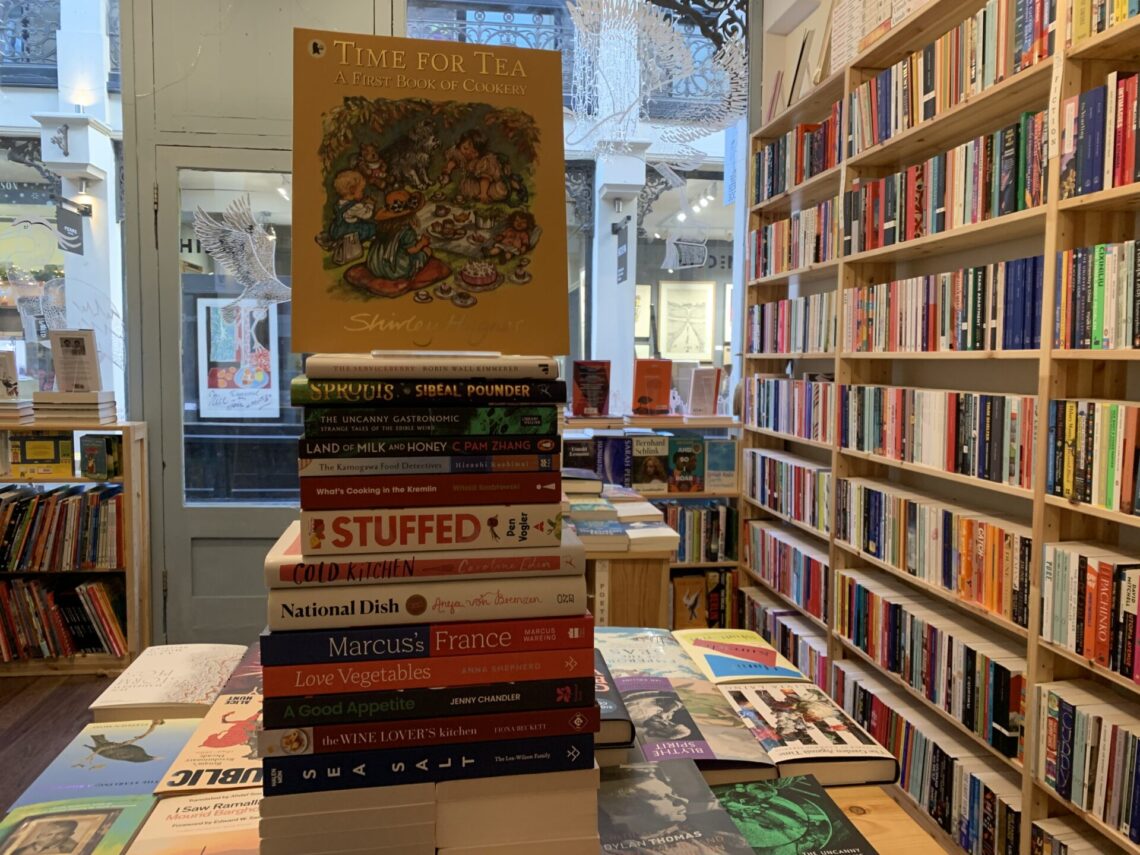
Jenny has also written brilliant books for children, encouraging a love of cooking, eating well and enjoying food together. Additionally, every child ought to have a copy of Time for Tea: A First Book of Cookery by Shirley Hughes. The recipes are shaped by playful stories and the illustrations full of charm. Pancake flipping is taken very seriously. Tomato pops are a genius invention.
If an Instagram faux pas does mean I can no longer visit France, at least I can do so through the latest book from (Englishman…) Marcus Wareing. Marcus’s France is rather heavenly. But, please let me back in, mes amis: I want to go to Land and Monkeys.
Wareing’s book gives some personal twists on ‘French classics.’ I’ve been reading National Dish by Anya von Bremzen in which the writer explores the development of national cuisines including the significance and implications of such a phrase. She begins in France investigating the pot-au-feu whilst indulging in pink mochi balls at a Korean épicerie and noting, ‘I’m a Jewish-Russian American national, born in a despotic imperium long deleted from maps. I speak with a heavy accent in several languages, lead a professionally nomadic existence as a food and travel writer, and own an apartment in Istanbul.’ Her family make gefilte fish for Passover and ham for Russian Orthodox Easter…
I am currently en route to Tokyo with von Bremzen, having sojourned in Naples and met the One True Pizza Maker, Il Pizzaiolo. There were several of these who could not agree on how to make the archetypal Neapolitan pizza. One is prepared to suffer trying them all…
Travelling through food writing has become a favourite pastime. Earlier this year I recommended Cold Kitchen by Caroline Eden, in which her basement kitchen in Edinburgh becomes a portal to Ukraine, Turkey, Poland and elsewhere, each poignant chapter ending with the recipe for a transportive food.
I’m planning to complement National Dish and Cold Kitchen with Pen Vogler’s Stuffed: A Political History of What We Eat and Why it Matters: I may have to turn straight to the chapter entitled ‘Crises: mustard and pickles.’
And, for another helping of political food history, What’s Cooking in the Kremlin: A Modern History of Russia Through the Kitchen Door by Witold Szablowski is a fascinating way into uncovering the history – and the cooking up of false versions of that history – of Russia through the chefs of the Russian elite, the kitchen staff at Chernobyl and a woman catering for soldiers at a Soviet airbase in Afghanistan.
There are so many courses on this menu that you may already be full, which is good if you plan to read the novels Land of Milk and Honey by C Pam Zhang or The Kamogawa Food Detectives by Hisashi Kashiwai and its sequel because my goodness the food descriptions will make you hungry.
What might make you less so is The Uncanny Gastronomic edited by Zara-Louise Stubbs, which collects some weird and macabre food writing from Shirley Jackson (the kitchen is not a safe place in her unsettling world) to M. F. K. Fisher (if your grandmother doesn’t trust the cook, neither should you) to Saki to Angela Carter and more.
To cleanse the palette, everyone must read The Serviceberry by Robin Wall Kimmerer. In a short and erudite essay, she moves from picking these abundant berries (think blueberry, apple, rosewater and almond flavours in one) to a comprehensive argument about gift economies.
Time to end on something sweet, you might think. Or a digestif. Round up as you started, with a coffee. But no. I have saved the best until last: Sprouts by Sibéal Pounder. This is an adventure like no other where every food is candy cane shaped and, no matter what bright colour the cane may be it tastes of…? The best vegetable ever. The most delicious, versatile, please-fry-it-with-marmite-and-celery-salt-and-pass-me-an-overfull-bowl-of-it vegetable of them all. The mighty Brussels sprout. It’s enough to make you embrace the winter cold. Have a brilliant time with Gryla Garland as she escapes the Mince Pie Isles to rescue the spirit of sprouts (ed. Christmas?)…
May your weekend sprout with gusto; I look forward to seeing your exquisite photographs of this verdant marvel,
Lizzie
Featured in the newsletter
-
 The Restaurant of Lost Recipes£14.99
 -
National Dish£12.99
-
Marcus’s France£26.00
-
What’s Cooking in the Kremlin£10.99
-
Time for Tea: A First Book of Cookery£8.99
-
The Uncanny Gastronomic£10.99
-
Stuffed£10.99
-
Land of Milk and Honey£9.99
-
The Wine Lover’s Kitchen£22.00
-
The Kamogawa Food Detectives£9.99
-
Cold Kitchen£18.99
-
Love Vegetables£20.00
-
A Good Appetite£20.00
-
Green Kids Cook£14.99